
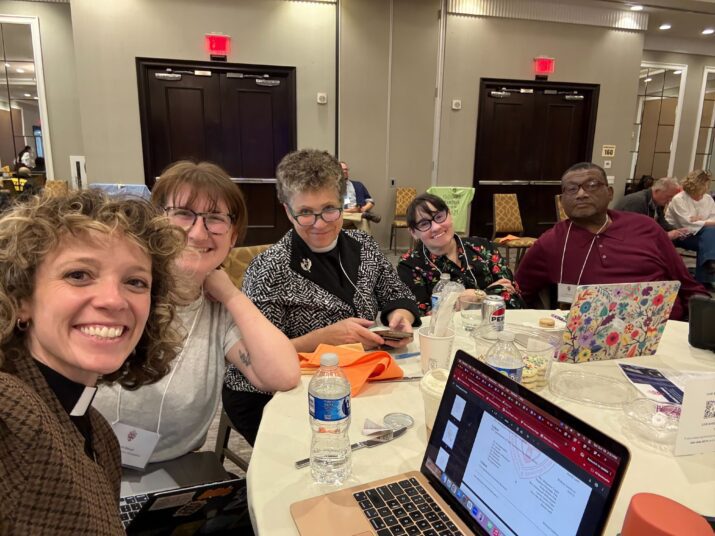
A monthly feature brought to you by the St. Peter’s History Committee. This article was written by parishioner Keith Betten.
I recently watched, for the first time, a 2023 PBS documentary titled “The Philadelphia Eleven” that recounts the initiative to ordain women into the priesthood of the Episcopal Church, a half century ago. Difficult to imagine now (especially as St. Peter’s is blessed to have two female rectors in Rev. Laurie Wurm and Rev. Sarah Hedgis-Kligerman), but at the time, that effort was highly controversial, which led me to wonder: what was St. Peter’s official position on that issue when the prospect of female ordination was placed before the National Convention in 1970, 1973, and again, in 1976—it failed on the first and second attempts. Who were the delegates who represented St. Peter’s at those conventions? Were any of them women, and how did they vote? (A side note that the photo accompanying this article shows the St. Peter’s delegates to the 2025 Convention, with Rev. Wurm, Rev. Hedgis-Kligerman, and three parishioners delegates, two of whom are women!)
In hopes of finding answers to those questions, I reviewed all of the vestry minutes as recorded during the late ‘60s and on up through to the end of 1976. That was a time of great social, cultural, spiritual, and political upheaval in the United States. In addition to massive (sometimes violent) anti-Vietnam War protests, the nation witnessed the emergence of the Black Power Movement and, in New York City, of the Stonewall riots, each of which independently spawned new, separate and ultimately more durable phenomena: “Black Pride” and “Gay Pride”—both of which, in time, would have their own impact on the social, cultural, and spiritual sensibility at St. Peter’s. (Each of these developments should and needs to be the focus of future Spire “History Committee” articles.) But for our purposes here, it was during those same years that the “Women’s Liberation Movement” came in to full swing. I wondered: what was the status of women at St. Peter’s when that process began and how might that have changed over the course of those tumultuous times?
My reading of the minutes through the late ‘60s clearly indicated that “the ladies” were fully engaged in many church activities (many in leadership roles), but those were largely in auxiliary, rather than in official capacities. Vestry attendance records, month after month, and year after year, going back more than 200 years, invariably referenced, in addition to the (male) rector, that all “vestrymen” were, in fact, exactly that… “Messrs.”
But then, quite cosmically, in April 1970, when four vestry positions needed to be filled (and, of course, because membership in those days was not great, the “gene pool” was limited), one of the nominees, a Miss Marcia Rogers was elected as a woman, to serve the parish in that capacity for the first time in our long history. (Some of us still fondly remember Marcia and know that she undoubtedly added a quiet but determined voice to that body). A year later, in April 1971, she was joined by Miss Mary Poole and Mrs. Cornelia Bocchini. As an aside, it is interesting to note that, in recording Mrs. Bocchini’s election in the minutes, the secretary chose to use her own, given first name (Cornelia) rather than referring to her as “Mrs. Richard Bocchini,” which was her husband’s first name as was often the custom at that time. Two years later, all three were referred to as “Ms.” in the minutes.
Turning back to the proposed ordination of women and the “Philadelphia Eleven,” despite the fact that the prospect of female priests was on the agendas of three consecutive National Conventions, and despite the fact that 11 women were ordained, (first, “invalidly” and subsequently, “irregularly”) as Episcopal priests at the Church of the Advocate, on July 29, 1974, right here in Philadelphia, the matter appears not to have received a single word of mention in the minutes of the vestry of St. Peter’s Church during those years. Oddly, not even the selection/appointment of delegates to the conventions was referenced, so that we have no indication if any women were included. Apparently, the subject was never introduced as an agenda item at any of those meetings. Might that have been because the parish could not take an official position on the issue, or because it chose not to? Maybe, we will never know, or maybe, hopefully, there is someone, or several of you out there who lived through all of that, and who will share it with us, before those specifics are lost to us forever.
In any case, how short-sighted was it, for all of those centuries, for the Anglican Church and the Episcopal Church to have denied themselves that well-spring of spiritual gifts which was and is possessed by half of their/our populations, and how blessed are we at St. Peter’s today that 50 years ago, this year, by the force of their own calling, women became, for the first time, and for all time, priests of the Episcopal Church!
There were other female priests besides those listed. Monique (can’t remember her last name)(Ellison?) and Paulette Schiff (interim with Phillip Bennett before Ledlie came). And Maryann Younger was a Transitional Deacon who came from Christiana 100 in Delaware. And I believe there was another transitional deacon at the same time as Sarah. We have raised a few up to the priesthood as well, I think Judy Buck-Glenn was the first. I’m gonna be thinking about this all afternoon!
I sent a copy of this article to Marcia’s cousin. He’ll read it to her. Maybe it will spark some memories of the congregation’s attitudes toward female ordination.