
A monthly feature brought to you by the St. Peter’s History Committee. This article was written by parishioner Mike Krasulski.
Among the many lives that have passed through St. Peter’s over the past two centuries, few carry the quiet weight of James Kenichi Kikushima, known to his family and to the world as Jimmy.
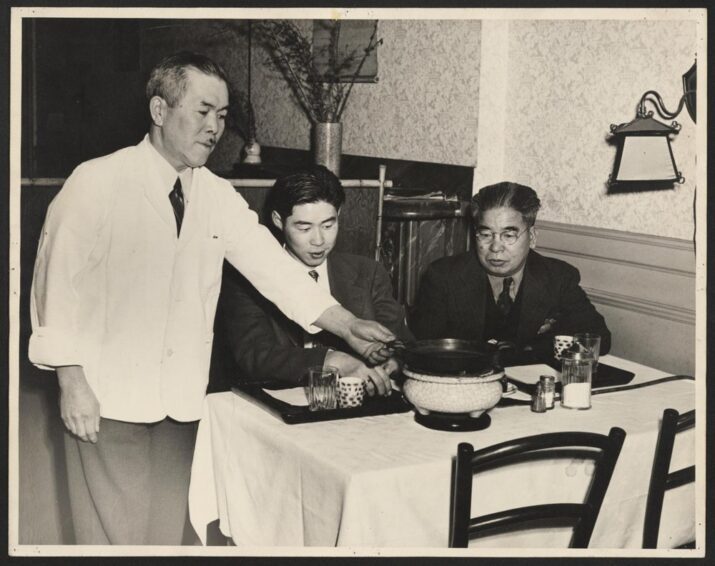
Jimmy was born in 1925 in the Frankford section of Philadelphia to James Kenichi Kikushima Sr., born in Tokyo in 1896, and Elizabeth Nesbitt Jones, born in 1897 in Kensington and baptized and confirmed at the Free Church of St. John there. James Sr. and Elizabeth married at St. John’s and soon after started a small Japanese lampshade manufacturing company in Frankford. The business closed by 1929, and the family turned to a new venture, opening a Japanese and Asian restaurant at 16th and Spruce Streets that quickly became a popular Philadelphia dining spot.
Jimmy and his sister Elizabeth were baptized at Christ Church, and in 1927 the family moved its church membership to St. Mark’s, Frankford. But St. Peter’s would come to define Jimmy’s spiritual and social life. He entered the Choir School around 1934 or 1935, and in April 1936 he and his sister were confirmed here. He finished his time at the Choir School in 1939, yet he did not leave St. Peter’s behind. For the next five years, until he left for New York City in 1944, Jimmy returned every week for social activities and choir rehearsal.
Those weekly returns took on a deeper meaning as the world around Jimmy grew hostile. Letters preserved among the papers of Dr. Harold Gilbert, now at the Diocesan Archives, hint at what those years were like. At the outbreak of the Second World War, life grew hard for Jimmy and his Japanese-born father. The family restaurant, once a point of pride, made them targets of neighborhood suspicion, and Jimmy bore the brunt of the anti-Nisei and anti-Issei hostility that gripped the country. He went on to attend Central High School, admitted automatically as a graduate of St. Peter’s under the Philadelphia School Board’s policy, but conditions there proved even harder. He began going by the name James Kenny, apparently hoping a new name might bring some acceptance. It did not spare him the slurs and hostility of his classmates, nor the harder pain of watching his parents endure the same treatment.
Against that backdrop, the evidence suggests something else entirely at St. Peter’s. Despite the hysteria of the era, Jimmy was “simply one of us.” The various St. Peter’s Choir School alumni would leave Central High together, head to St. Peter’s, shoot baskets in the gym, share Friday dinner, and then rehearse, a routine described as more a weekly reunion than a rehearsal. It is a striking contrast: a young man ridiculed and diminished in nearly every other corner of his life, finding at St. Peter’s a place where none of that mattered.
The evidence suggests that St. Peter’s was not merely a childhood parish Jimmy happened to attend. It appears to have served as a genuine refuge during one of the most difficult periods of his life, a place where his identity was not a liability but simply a fact among friends. That impression is reinforced by two further threads. The first is Jimmy’s own contact with Dr. Gilbert decades later, a connection that endured long after his Choir School years had ended. The second, perhaps more telling, involves the Rev. Frederick Blatz, who served as rector of St. Peter’s during Jimmy’s youth. Years later, when Blatz had become rector of St. Paul’s Church in Westfield, New Jersey, Jimmy sought him out again, this time to baptize his own children. Jimmy was living in Philadelphia at the time; he could easily have had his children baptized here at St. Peter’s, yet he chose to bring his family north to New Jersey so Blatz could perform the rite. It is hard to read that choice as anything other than a mark of lasting trust and affection for the priest, and by extension for the parish, that had stood by him when so much of the world had not.
Jimmy went on to a remarkable career, skating with Sonja Henie’s ice shows, joining the original Broadway cast of The Song of Norway, and eventually founding a series of ballet schools across the Philadelphia area. He died in 1982 at the age of 57. But long before any of that, in the cold years of the early 1940s, St. Peter’s offered him something he could find almost nowhere else: a place to simply be Jimmy.
Photo attribution: Jimmy Kikushimna’s Oriental Restaurant at 1620 Spruce St. in Philadelphia, War Relocation Authority Photographs of Japanese-American Evacuation and Resettlement, BANC PIC 1967.014 v.AX1, The Bancroft Library, University of California, Berkeley.